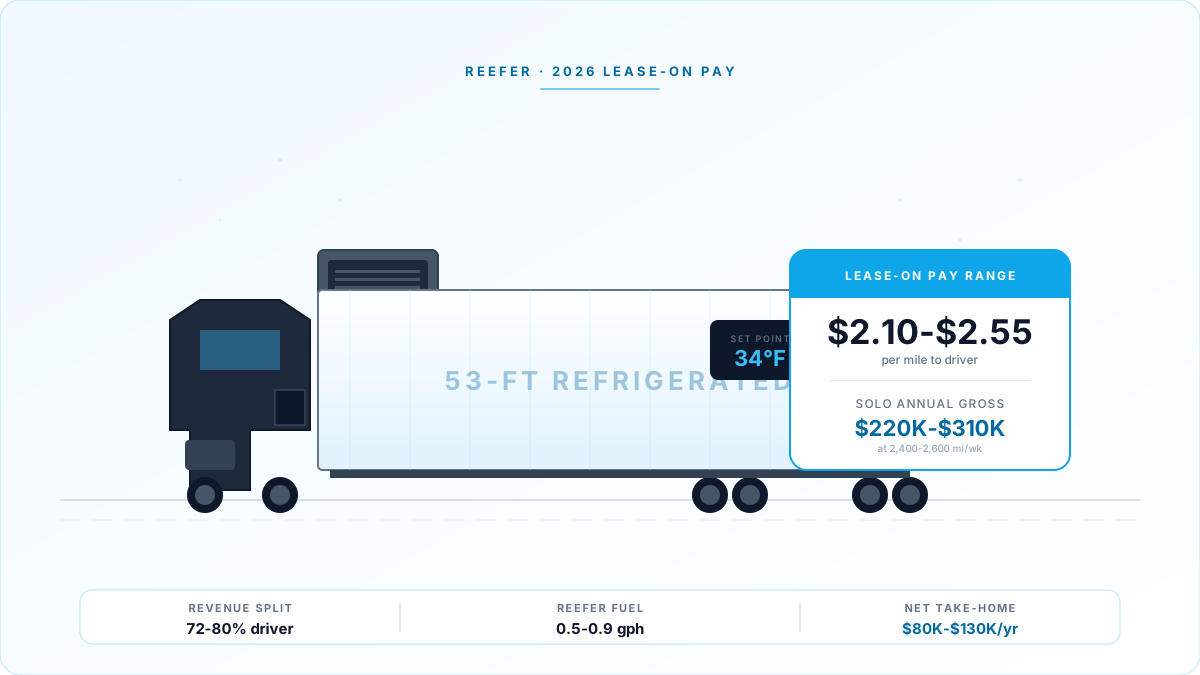
Why reefer pays more — the real economics
Reefer freight commands higher rates for three structural reasons. First, cargo value per truckload is higher — a 40,000-lb load of frozen beef carries $150K-$200K in product value versus $30K-$80K on a typical dry van. Shippers of high-value temperature-sensitive freight pay for carrier reliability and claim-reserve capacity. Second, equipment is more expensive: a new reefer trailer runs $85K-$110K versus $35K-$45K for a dry van, and the reefer unit alone is $15K-$25K. Carriers amortize that capital through rates. Third, the pool of qualified drivers is smaller — reefer requires temperature discipline, delivery-window tightness, and produce/food handling knowledge that not every OTR driver has.
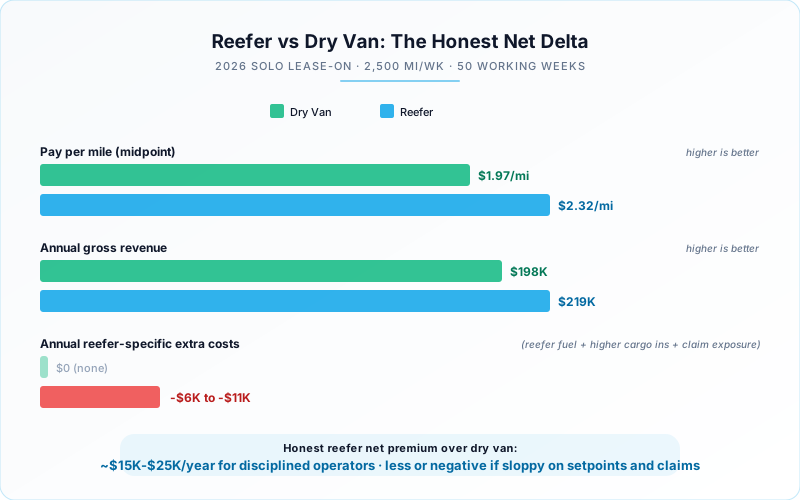
For a disciplined solo operator, those factors translate to $30,000-$50,000 more in annual gross than dry van at the same mileage. The question is how much of that gross survives once reefer-specific costs hit.
Real 2026 settlement math — reefer specifics
A realistic weekly settlement for a solo reefer lease-on driver running 2,500 miles in 2026:
| Line | Amount |
|---|---|
| Gross line haul (2,500 mi × $2.90) | $7,250.00 |
| Fuel surcharge (2,500 mi × $0.52) | $1,300.00 |
| Gross revenue | $8,550.00 |
| Carrier split (25% of gross) | -$2,137.50 |
| Cargo insurance (higher for reefer) | -$250.00 |
| Physical damage + reefer unit coverage | -$175.00 |
| Tractor fuel card (~340 gal @ $3.80) | -$1,292.00 |
| Reefer fuel (~45 gal @ $3.80) | -$171.00 |
| ELD / qualcomm / IFTA / occ acc | -$145.00 |
| Net settlement to driver | $4,379.50 |
Illustrative. Reefer gross per mile and fuel prices vary significantly by lane and season. Fuel surcharge often separately passes through reefer-fuel reimbursement on some programs (noted below).
Over 50 working weeks, that settles ~$219,000 in driver-side net — roughly $21,000 more than the parallel dry van example. Against dry van net of ~$198,000, reefer shows a realistic $15K-$25K/year advantage after all carrier deductions. Before personal expenses (truck payment, maintenance reserve, self-employment tax), that's the honest math.
Reefer fuel — the line that eats nets if you ignore it
The reefer unit is a 20-25 hp diesel engine mounted on the nose of the trailer, burning its own diesel from a 50-gallon tank. Burn rate depends heavily on outside temperature and set point:
- Continuous cool on frozen freight (0°F setpoint): 0.7-0.9 gallons/hour during sustained operation. At 80°F outside, this climbs to 1.0-1.2 gph.
- Fresh produce (34-38°F setpoint): 0.4-0.6 gph in cool weather, 0.7-0.9 gph in summer.
- Start-stop cycling (moderate ambient):0.3-0.5 gph average.
For a week running 50 hours under load, that's 20-50 gallons of reefer fuel — $75-$190 at 2026 prices. Over a year, $4,000-$10,000. How your carrier handles this matters enormously:
- Best case: Separate reefer fuel card reimbursed 100% through a dedicated fuel surcharge. Net impact to you: zero.
- Typical case: Reefer fuel rolled into the main fuel surcharge at a blended rate. Impact: you cover reefer fuel out of your per-mile pay, but the per-mile rate is set to compensate.
- Worst case: No reefer fuel reimbursement. You eat the full cost. Unacceptable — walk away from any program that does this.
Cargo-claim risk — what you're really on the hook for
A temperature excursion on a reefer load can total the entire cargo value. Frozen beef warms 10°F in a 2-hour HVAC-unit failure and the FDA rejects the load — that's a $150K claim. Fresh produce sits an extra 90 minutes at a close-to-threshold temperature and the receiver refuses it — $80K claim. These aren't hypotheticals; they're routine enough that the reefer insurance industry is a dedicated specialty.
In a well-structured lease-on program, cargo insurance is carried by the carrier's master policy. You pay a monthly deduction (typically $200-$300 for reefer, versus $100-$150 for dry van) and the carrier's policy covers the claim. What you're personally liable for depends on the contract:
- No personal liability for covered claims:Good programs write contracts so the carrier's insurance pays out and you're not on the hook personally unless gross negligence is proven.
- Deductible exposure: Some programs require you to share the first $1,000-$5,000 of any claim (the policy deductible). Acceptable if disclosed upfront.
- Deadly: "driver-responsible" contracts.Some predatory carriers write the lease so any preventable cargo loss is fully on the driver. One claim can wipe out a year of earnings. Read the lease carefully; walk away if you see this.
Regardless of insurance structure, chronic cargo claims show up in your Pre-Employment Screening Program (PSP) record and affect your employability across the industry. The disciplined reefer drivers treat every load like it's uninsured — pre-cool the trailer, verify the setpoint, check product temperature at loading, log temperature every 2 hours, document any delay.
Reefer lane structures — what actually runs year-round
Reefer freight is more seasonally variable than dry van. The year-round backbone is three primary lane clusters:
- California Central Valley → East Coast.Fresh produce (lettuce, berries, citrus, vegetables) year-round, with peak April-September. The flagship reefer lane — highest rates, tightest delivery windows, most competitive lane among reefer carriers. $3.00-$3.40/mi gross is realistic for this lane. Backhaul is typically frozen beef or pharma.
- Midwest meat belt (IA/NE/KS) → major metros.Frozen beef, pork, poultry, dairy. Year-round freight with slight December peak. Rates $2.80-$3.10/mi gross typical. The workhorse lane that carries most reefer lease-on operators through the winter.
- Southeast (FL/GA/SC) → Northeast metros.Fresh produce year-round with spring-summer peak, frozen poultry year-round. Rates $2.70-$3.00/mi gross. Weather delays during hurricane season (August-October) can be punishing.
Seasonal peaks worth knowing: produce harvest (April-September) drives California rates 15-25% above baseline; holiday food freight (mid-October through mid-December) drives all three major corridors 10-20% higher; January-February is the soft season in reefer and rates bottom out.
Equipment requirements — reefer specifics
Reefer lease-on programs almost always provide the reefer trailer (you rarely need to own one). Requirements for your tractor are similar to dry van with one reefer-specific addition:
- Tractor age: 2015+ preferred, 2012-2014 accepted at some programs. Same as dry van.
- Engine emissions: EPA 2010-compliant required.
- APU preferred: Much more valuable on reefer than dry van because reefer runs in hot-weather layovers require running the tractor to keep the driver comfortable. An APU saves 2-3 gallons of tractor diesel per idle night.
- Reefer unit (carrier-provided): Newer carriers typically run Thermo King Precedent or Carrier Vector units with remote temperature monitoring. Ask about the average reefer trailer age — units over 8 years old have more frequent maintenance issues.
- Load-securing: Reefer loads often have dunnage / load-locks / load bars required. Carrier supplies most of this; your truck should have space for it.
Who should (and shouldn't) step into reefer lease-on
Good reefer lease-on fit:
- 2+ years of OTR experience, ideally 6+ months of prior reefer or temperature-controlled company-driver work.
- A cash reserve of at least $15,000 specifically for tractor repair (not a reefer trailer repair — the carrier handles that, but a tractor engine failure stops reefer revenue too).
- Comfort with tighter delivery windows than dry van. Missing a 6 AM appointment on produce costs you the load and sometimes the lane.
- Discipline around pre-cooling protocol, setpoint verification, and product-temperature documentation. Every reefer driver who lasts has this.
- Tolerance for the produce season vs winter gap. March-April and October-November can be slow. Plan for variable weekly mileage.
Poor reefer lease-on fit:
- First-time lease-on driver — start with dry van, get used to the lease-on structure first.
- Cash-reserve-thin operators. A single preventable cargo claim (if contract exposes you to deductibles) can consume 2-3 months of net.
- Drivers who struggle with appointment windows — reefer is unforgiving in a way dry van never is.
- Operators who won't document pre-cool, setpoint, product temp, and delays. Documentation IS the insurance.
The 6 questions to ask before signing a reefer lease
- How is reefer fuel handled? Separate reimbursement is best; blended into surcharge is acceptable; unreimbursed is a dealbreaker.
- What's my cargo-claim exposure? Get this in writing — deductible share, gross-negligence standard, process for disputing claims.
- What's the trailer age and maintenance policy? Newer trailers break less; clear maintenance responsibility matters when the reefer unit alarms at 2 AM.
- What's the lane mix and seasonal variability? Ask to talk to two current drivers about their mileage last January and last July. That's your real range.
- What's the detention/layover pay?Reefer detention is longer on average than dry van (produce receivers are notorious) — $25/hour minimum after 2 hours is reasonable.
- What happens if the reefer unit fails mid-load? Who pays for the rescue, the hotel, the backup trailer? This should be documented; it's not hypothetical.
Related reading on TruckingJobsInUSA
- Lease-On Program Overview — the decision framework and hub page.
- Dry Van Lease-On Programs — the typical entry path before reefer.
- Reefer Driver Jobs — if company-driver reefer is a better fit than lease-on.
- Owner-Operator Startup Guide 2026 — the standalone-authority alternative.
- Salary Guide by State — regional pay variation affects reefer lane selection.
Interested in a reefer lease-on?
Tell us about your truck, experience, and timeline. We'll match you with a reefer program that fits — dedicated, regional, or long-haul.
Reefer Lease-On FAQ
How much more does reefer lease-on pay versus dry van?
Reefer lease-on pays roughly $0.30-$0.40 more per mile to the driver than dry van in 2026 — typically $2.10-$2.55/mile versus $1.80-$2.15/mile on dry van. For a solo driver at 2,500 miles/week, that's an extra $35,000-$50,000 in annual gross. The catch: reefer expenses are meaningfully higher (reefer unit fuel, maintenance, cargo-value insurance, time-sensitive delivery risk). The honest net delta is usually $15,000-$30,000/year more in take-home, not the full $35K-$50K you'd see on the gross line.
What is reefer fuel and how much does it cost?
The refrigeration unit on a reefer trailer runs on its own diesel supply separate from the tractor. At 2026 diesel prices, a typical reefer unit burns 0.5-0.9 gallons per hour when cooling produce or frozen freight — roughly $0.08-$0.18 per mile of added fuel cost versus dry van. Most lease-on carriers reimburse reefer fuel through a separate fuel-card account; some roll it into the overall fuel surcharge at a blended rate. Ask explicitly how reefer fuel is handled before signing — unreimbursed reefer fuel can quietly erase $8,000-$12,000/year from your net.
Do I need my own reefer trailer to lease on?
Usually no. Most reefer lease-on carriers provide the reefer trailer as part of the program, either through trailer interchange (you pick up their trailers at terminals) or through a trailer-rental arrangement built into the contract. Carriers that require you to own your own reefer trailer are rarer and typically pay 3-5 points higher on the gross split to offset the $80K-$120K capital commitment of owning a new or late-model reefer trailer.
What CDL experience do reefer lease-on programs require?
Most reefer programs require 18-24 months of verifiable OTR experience — more than dry van (12-18 months). Some require prior reefer or temperature-controlled experience specifically. The higher bar is partly about handling the operational complexity (pre-cooling, setpoint discipline, BOL compliance with temperature notes) and partly about insurance — cargo claims on reefer freight are much higher than dry van because the cargo value is higher and temperature excursions can total an entire load.
How bad is cargo claim risk on reefer?
Significant. A single temperature excursion on a 40,000-lb load of frozen beef can generate a $80,000-$180,000 cargo claim. Even a load of fresh produce that warms out of spec during a 2-hour delay at a receiver can become a full-claim writeoff. In a well-run lease-on program, cargo insurance is carried by the carrier and you're not personally on the hook for most claims — but you can still be terminated for preventable temperature excursions, and chronic claim history will show up in your PSP. Drivers who do reefer successfully are obsessive about pre-cooling, setpoint monitoring, and documenting temperature throughout the haul.
What lanes does reefer lease-on typically run?
Year-round reefer freight runs primarily along three corridors: (1) California Central Valley to East Coast — fresh produce, highest reefer demand, highest rates; (2) Midwest meat belt (Iowa/Nebraska/Kansas) to all major metros — frozen beef, pork, chicken, dairy; (3) Southeast produce (Florida, Georgia, South Carolina) to Northeast metros. Seasonal spikes happen April-July (produce peak) and November-December (holiday food freight). The cross-country California → Northeast lane is the single best-paying reefer lane in most programs — $3.00-$3.40/mile gross is realistic on that corridor in 2026.
What's the realistic net difference between reefer and dry van lease-on?
For a disciplined solo driver running 2,500 miles/week, reefer typically nets $15,000-$30,000 more per year than dry van after accounting for reefer fuel, higher insurance, and occasional cargo claim deductible exposure. For drivers who aren't meticulous about setpoints and pre-cooling — or who chase too-good-to-be-true cross-country lanes without planning backhauls — reefer can actually net less than dry van due to claims, empty miles, and rejected loads. The premium over dry van rewards discipline; it doesn't forgive sloppiness.
Is it worth getting into reefer as my first lease-on?
Usually no, unless you have prior reefer experience from a company-driver job. Starting lease-on is already a steep learning curve — new settlement math, new dispatch relationship, new freight-network dynamics. Adding reefer complexity on top (pre-cool protocol, setpoint discipline, cargo-value risk management) compounds the learning curve and raises the cost of early mistakes. The typical recommended path is 12-18 months of dry van lease-on followed by a transition to reefer, where you've learned the carrier systems and can focus the second learning curve purely on the equipment.